
Don't Let Your Container Get Stuck: The Insider’s Handbook to Shipping & Clearing Used Clothing
1. Introduction: The $5,000 Mistake Hiding in Your Shipment
Imagine this: You’ve invested your capital, found a great supplier, and your 40ft HQ container of premium used clothing is finally arriving at your local port. You’re ready to make a profit. But then, disaster strikes. The container is flagged by customs. You’re missing a single document. Suddenly, you’re facing $150 per day in demurrage fees, and your "profit" is evaporating before your eyes.
This nightmare is the #1 reason new importers fail in the used clothing trade. The truth is, sourcing good clothes is only half the battle; shipping used clothing legally and efficiently is what separates the professionals from the amateurs. In this insider’s handbook, we will demystify the complex world of international logistics, customs documentation, and clearance secrets to ensure your container moves from the ship to your warehouse without costly delays.
2. The First Hurdle: Why Used Clothing is "High-Risk" Cargo
Unlike new electronics or furniture, used clothing is treated as "sensitive" or "high-risk" cargo by customs authorities worldwide. Why?
- Hygiene & Bio-Security: Governments fear that used textiles might carry pests, bacteria, or diseases.
- Economic Protection: Some countries impose restrictions to protect their local textile industries.
- Quality Standards: Authorities want to ensure the goods are "reusable" and not just "waste" being dumped into their country.
Understanding this "risk profile" is the first step. It explains why you need specific certificates and why the documentation must be flawless.
3. The "Golden Documents": Your Passport to Clearance
To successfully navigate the process of shipping used clothing, you need a perfect set of documents. Missing even one can halt your entire shipment.
| Document Name | Purpose | Critical For |
|---|---|---|
| Bill of Lading (B/L) | The contract & receipt for the shipment. | All Shipments |
| Commercial Invoice | States the value of the goods for taxes. | All Shipments |
| Packing List | Details the contents, weight, and bales. | All Shipments |
| Fumigation Certificate | Proves the goods are pest-free. | Africa & LatAm (Mandatory) |
| Certificate of Origin | States where the goods were made/sorted. | Tax/Duty Calculation |
| CNCA / SONCAP | Specific conformity assessments. | Nigeria (Mandatory) |
4. Deep Dive: The Critical Fumigation Certificate
For markets in Africa and Latin America, the Fumigation Certificate is non-negotiable.
- What is it? It’s an official document proving that your wooden packaging and the goods themselves have been treated to kill any potential pests (like insects or larvae).
- The Risk: If you arrive without it, customs may force you to fumigate at the destination port (which is expensive and slow) or even reject the entire container.
- The Solution: Always confirm with your supplier that the goods will be fumigated before shipping and that the certificate will be included in the document set.
5. Country-Specific Secrets: Nigeria, Kenya, and The Philippines
Every country has its own "unwritten rules" for shipping used clothing.
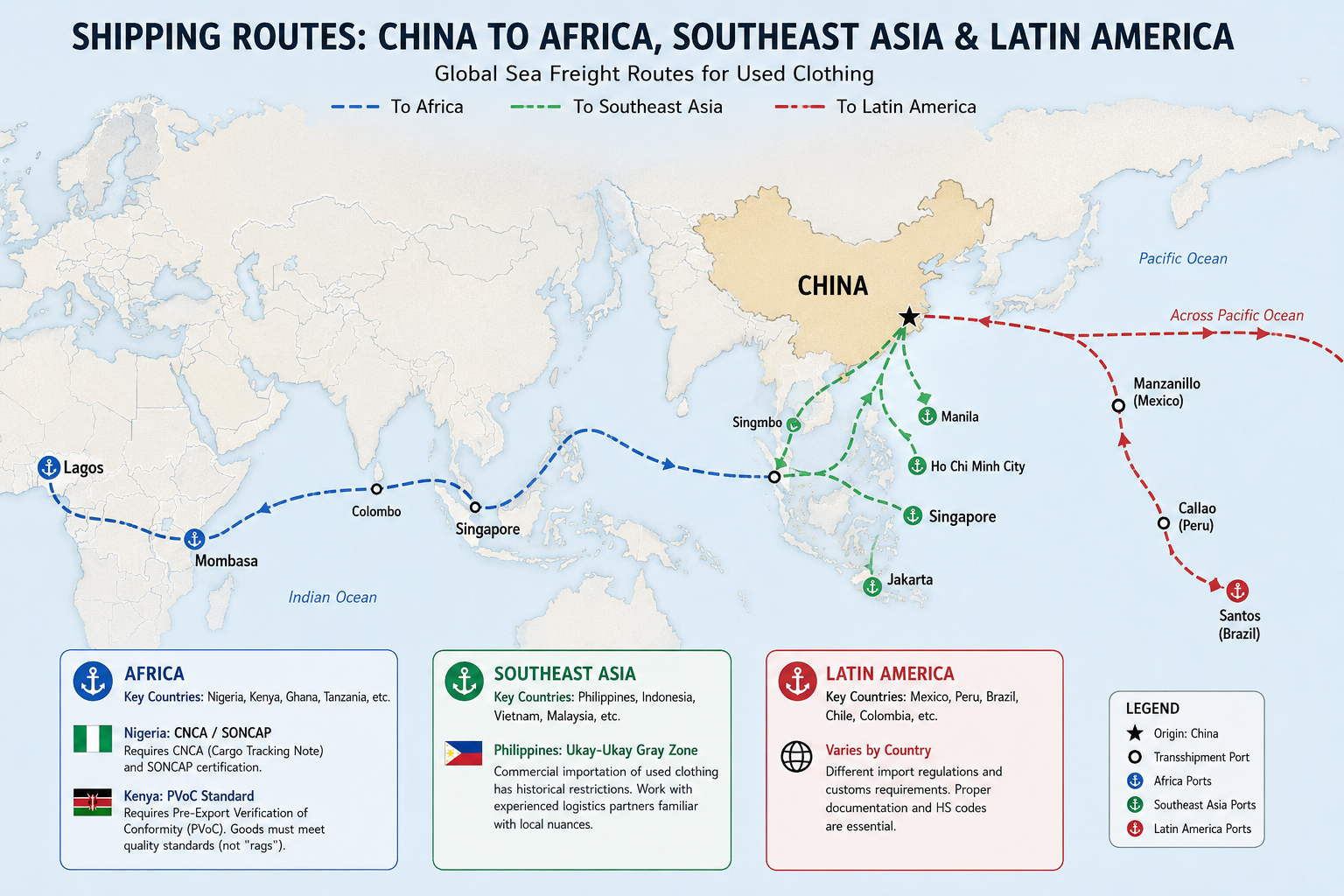
A. Nigeria (The CNCA/SONCAP Maze) Nigeria has strict import regulations. You will likely need a CNCA (Cargo Tracking Note) and potentially SONCAP certification. Failing to register your shipment before it leaves China can result in massive penalties at the port of Lagos.
B. Kenya (The PVoC Standard) Kenya requires a "Pre-Export Verification of Conformity" (PVoC). The goods must meet specific quality standards (e.g., they cannot be "rags") to be allowed entry.
C. The Philippines (The "Ukay-Ukay" Gray Zone) Technically, the commercial importation of used clothing has historical restrictions in the Philippines. Successful importers often work with experienced logistics partners who understand the specific local nuances and "consolidation" methods.
6. Logistics Engineering: 20ft vs. 40ft HQ Cost Analysis
Choosing the right container size directly impacts your shipping used clothing costs.
| Feature | 20ft Standard Container | 40ft HQ (High Cube) |
|---|---|---|
| Capacity (Volume) | ~33 CBM | ~76 CBM |
| Max Weight | ~28 Tons | ~26-28 Tons |
| Best For | Heavy goods, small budgets | Bulky goods, max volume |
| Cost Efficiency | Lower (High fixed costs) | Higher (Best $/CBM) |
The Verdict: For used clothing (which is bulky/light), the 40ft HQ is almost always more profitable because it offers double the volume for only slightly more freight cost. You "fill the space" before you "max the weight."
7. Avoiding the "Demurrage" Trap
Demurrage and detention fees are the silent killers of profit. These are fees charged when your container sits at the port for too long.
- The Cause: Usually caused by missing documents or slow customs clearance.
- The Cost: Can range from $100 to $200+ per day, escalating rapidly.
- The Fix:
- Prepare all documents before the ship arrives.
- Hire a competent local customs broker.
- Ensure your supplier provides a "Telex Release" or original B/L promptly.
Don't let a "cheap shipping" offer trap you. Read about logistics scams in How to Avoid Used Clothing Scams
8. The Importance of a Reliable Freight Forwarder
Your freight forwarder is your best friend in this process. A good forwarder will:
- Provide competitive ocean freight rates.
- Help coordinate the documentation.
- Track the container in real-time.
- Warn you of potential delays.
Warning: Be cautious of suppliers who insist on using only their "special cheap" forwarder. Sometimes this is a scam to hold your container hostage at the destination for extra fees. Always have the option to use your own trusted agent.
9. FAQ: Common Shipping & Clearing Questions
Q: How long does shipping take from China?
A: To Southeast Asia: 7-15 days. To East/West Africa: 35-55 days. To Latin America: 30-45 days.
Q: Who pays for the Ocean Freight?
A: This depends on your terms. FOB (Free On Board) means you pay for the freight. CIF (Cost, Insurance, Freight) means the supplier includes it in the price.
Q: What happens if my documents are wrong?
A: Your container will be held. This is why working with an experienced exporter who knows your country's specific requirements is crucial.
10. Conclusion: Smooth Sailing for Your Business
Mastering the logistics of shipping used clothing is what turns a hopeful trader into a successful, long-term importer. It’s not just about the clothes; it’s about the seamless journey from our factory floor to your local market. By preparing your documents, understanding your country’s rules, and partnering with experts, you can avoid the costly traps that sink so many new businesses.
At Guangzhou Tengchao Trading Co., Ltd. we don't just hand you the goods at the port. We provide full logistics support, ensuring your documentation is perfect and your shipment is fumigated, certified, and ready for smooth clearance.
Ready to ship with confidence?
The Denim Gold Mine: Why Wholesale Used Jeans Are the Safest Investment in the Second-Hand Trade
The Ultimate 2026 Guide to Avoiding Used Clothing Scams: How to Identify Reliable Factories in China
Related Article